I had just finished an agentic AI project with a Tier 1 regional bank. We were exploring how to reshape corporate banking and make it more intelligent with AI agents. My focus was the customer and user experience, and I was excited to show how the platform could be designed from scratch.
Then the main stakeholder, a global executive with more than 30 years in banking and digital platforms, stopped me:
“Selin, this is all great thinking, but the bank profits from uncertainty. This level of transparency and autonomy won’t be something we profit from.”
It was a real shock. My immediate thought was: wait, this is inevitable. I work in this field, and I see how quickly customers’ expectations are shifting as AI becomes more capable. AI will transform banking sooner or later. The big question is what it will cost the banks.
What it could cost banks
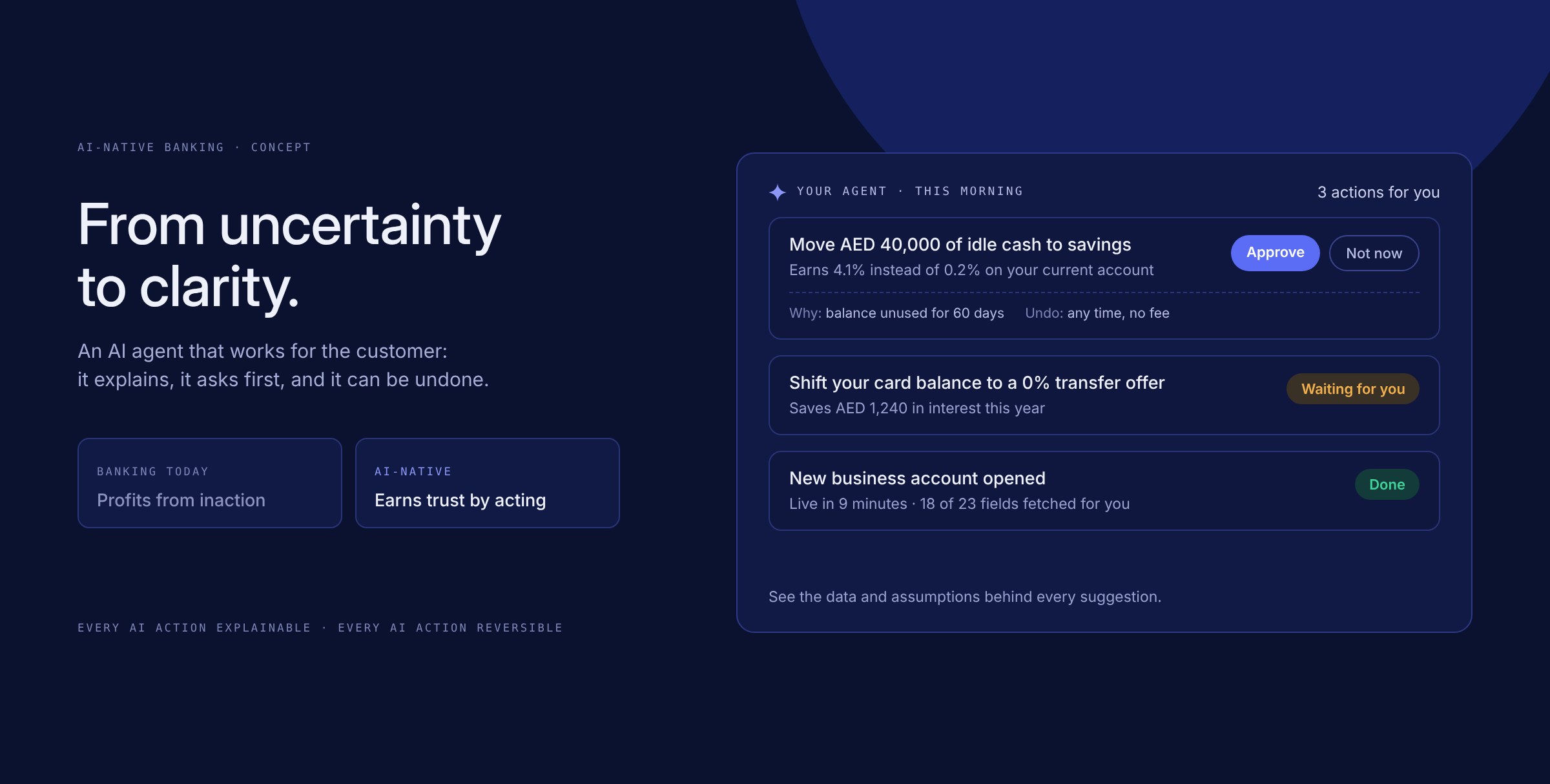
McKinsey puts numbers on that question in “Agentic AI will shake up banking, shrinking global profit pools” (November 2025). AI agents acting on customers’ behalf could open savings accounts and move money to get the best rates, or shift credit card balances to zero-interest transfer offers. Every one of those moves eats into a margin that depends on customers not acting. If banks don’t reinvent their business models, McKinsey estimates that global banking profit pools of about $1.2 trillion could shrink by up to 10% over the next five to ten years. Banks that lead on AI, meanwhile, could gain up to four percentage points in return on tangible equity over slow movers.
So the executive was right: transparency and autonomy threaten profits built on uncertainty. But customers will get them anyway, from someone. Banks need to reinvent their business models, and base their AI efforts on strategic priorities rather than a scattering of pilots and copilots.
Why I believe the future is AI-native
An AI-native bank is not a bank with a chatbot added on top. It is a bank redesigned around AI from the start. Bain draws exactly this line in “What it takes to build the AI-native modern bank” (July 2026): lasting advantage comes from redesigning the organisation around AI, not from adding new software to legacy processes. In Bain’s picture, an AI-native bank:
- Rebuilds customer journeys with AI, with intelligent agents orchestrating personalised experiences
- Builds trust and security in from the start, not at the end
- Keeps fixed systems, such as ledgers and payments, separate from probabilistic AI, such as fraud detection
- Treats clean, standardised data as more important than the algorithms themselves
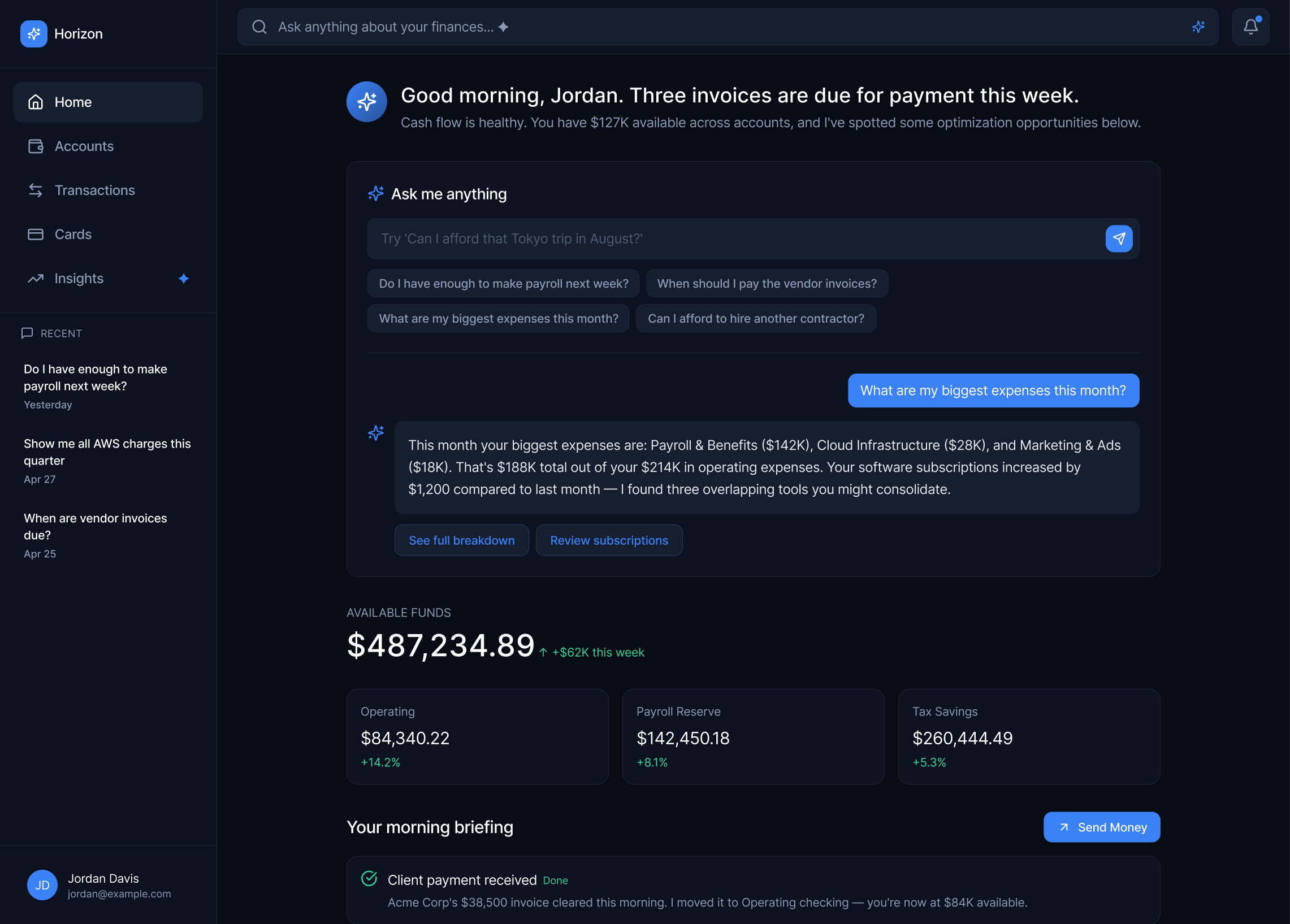
That last point is the foundation. An AI-native bank has to be fully machine-readable, supported by real-time data and clear policy layers that tell agents what they may and may not do. On top of that, customer journeys can be rebuilt from scratch, and hyper-personalised experiences can be orchestrated by intelligent agents rather than standard products.
Designing it: a prototype
I wanted to explore what an AI-native banking platform could look like from a design perspective. This isn’t a client project. It’s a self-initiated concept where I test ideas about trust, transparency and control before I bring them to client work.
Seven design principles
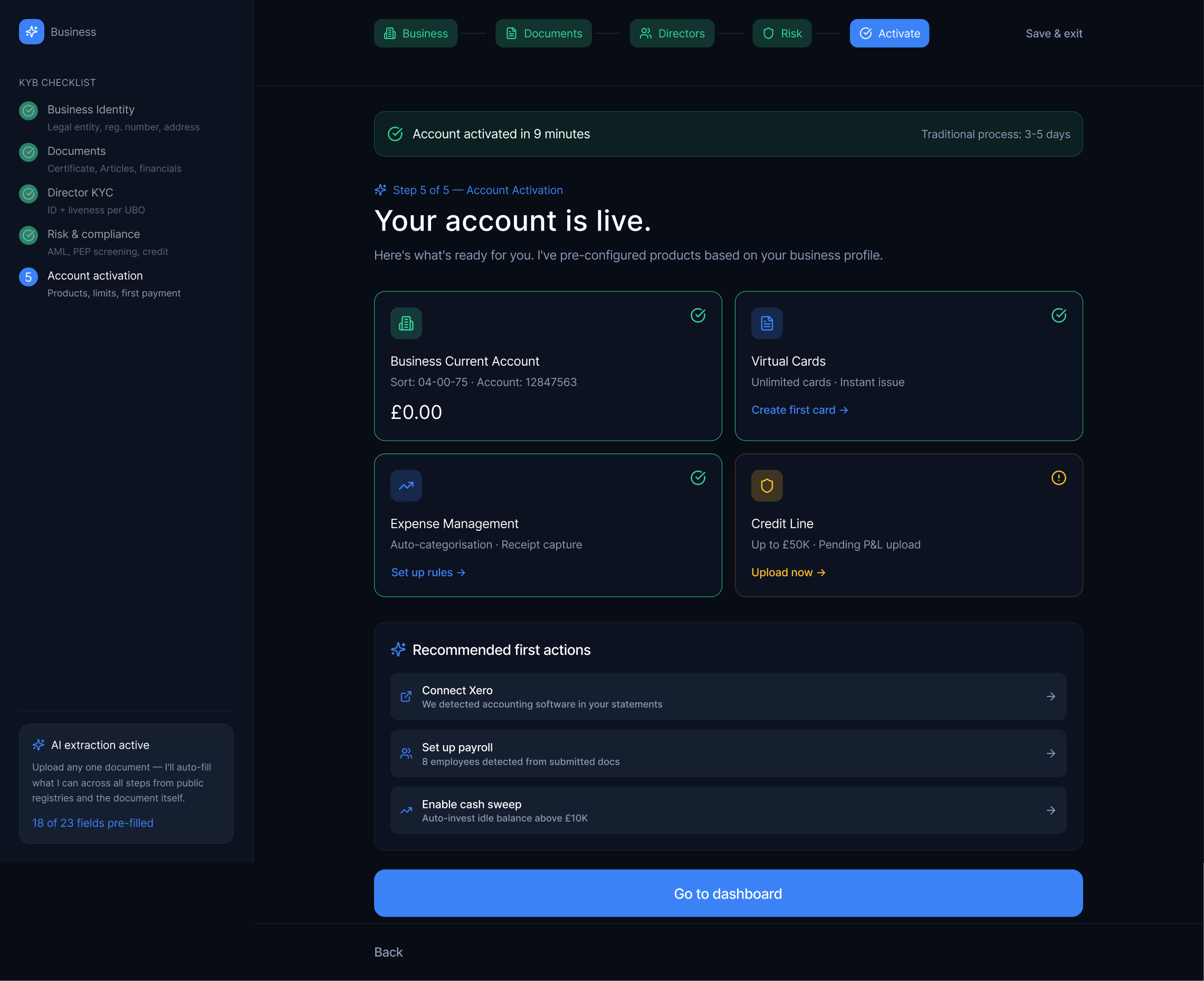
The new business customer onboarding prototype had to follow seven rules:
- Fetch before asking: anything in a public registry is fetched first; the user confirms rather than transcribes
- One field to start: the flow opens with the company name only
- Documents retrieved, not just uploaded: only bank statements and financial accounts need a real upload
- Directors are decoupled: each owner completes KYC remotely, in parallel, without blocking the applicant
- Risk runs in the background: AML, PEP, sanctions and credit checks finish before the user reaches the risk step
- Flags are non-blocking by default: each one shows a clear fix and says whether it blocks activation
- Activation is immediate: approval opens a live, pre-configured account, not a confirmation page