At a glance
- AI agents create value in business banking when they are built around the customer's lifecycle and the bank's strategic priorities, not around a catalogue of AI capabilities.
- Agents are only as good as the data they see. Real-time, standardised data is the foundation.
- Clear policy layers tell each agent what it may and may not do, and when a person must decide.
- The design work sits in the agentic flows and the orchestration logic: how one signal becomes one clear action for the right person.
The project
I worked with one of the region's top-tier banks to explore how agentic AI could be built into its business banking processes, starting from the bank's strategic priorities rather than from the technology.
My role was Lead Agentic Experience Architect: I designed the agentic flows and the orchestration logic, and the human-in-the-loop controls around them.
We started with workshop sessions to understand the bank's strategic priorities, and shortlisted the use cases together. They fell into two categories: risk, protecting the bank first, and business, acquiring, growing and retaining customers.
The project itself, with the lifecycle map, the process maps and the relationship manager dashboard, is in my case study Exploring AI Opportunities in SME Banking. This article focuses on what I learned designing it: the data, the policies and the orchestration that make agents work.
Why agents, and why business banking
The World Economic Forum's AI Playbook for Financial Services (June 2026), produced with Accenture, calls agentic AI a breakthrough for complex end-to-end processes. Instead of stopping at one answer, it coordinates several agents to move work forward: it requests information, triggers the next steps, escalates exceptions and completes the job. It connects what banks already have, from automation and rules engines to machine learning and generative AI. As the report puts it, “the challenge is scaling it.”
Business banking is where that matters most. Micro, small and medium-sized businesses account for 21% of banking revenue pools and grow faster than retail or corporate banking, according to McKinsey. Yet their needs change at every phase of the business life cycle, while relationship managers (RMs) cover large portfolios with limited time.
| Phase | What the business is doing | Its main financial need | Where agents can help |
|---|
| Start-up | Setting up operations | Access to capital and funding | Fast onboarding · lending based on early trading data |
| Early growth | Expanding capabilities and hiring the first employees | Cash flow management | Cash flow insights · POS lending readiness |
| Expansion | Investing in infrastructure and production capacity | Growth capital | Lending offers timed to real trading behaviour |
| Stability | Entering new markets and customer segments | Succession and transition planning | FX and treasury support · retention |
| Diversification | Diversifying the portfolio through M&A | Additional financial leverage | Ecosystem growth · continuous risk monitoring |
| Exit / M&A | Owners selling a majority or full stake | Valuing the business accurately | Relationship continuity · retention |
Source: business life cycle phases and needs adapted from Kearney analysis
Leading banks already show what works:
- Continuous monitoring beats periodic checks. HSBC, working with Google Cloud, replaced rules-based monitoring with AI and now detects two to four times more suspicious activity with 60% fewer alerts.
- Real behaviour beats static rules. MYbank, Ant Group's online bank, lends to small businesses based on their actual transaction data: a loan takes about three minutes, with a default rate around 1%. The International Bank of Azerbaijan, a WEF case study, approves micro-business loans in real time from transaction and credit bureau data, with zero manual intervention and non-performing loans under 4%.
- People stay in the loop where the risk is. Commerzbank keeps humans in the loop at all times in its agentic compliance work.
1. Real-time data is the foundation
An agent can only act on what it sees. Bain, in What it takes to build the AI-native modern bank, argues that clean, standardised data matters more than the algorithms themselves. The WEF playbook agrees: banks need real-time data ingestion and well-defined data products so agents act accurately, and data infrastructure is one of the hardest challenges in scaling AI.
Kearney shows the same logic across the whole business banking offer: business financials, credit bureau data, purchase history, point-of-sale and location data feed a credit scoring engine and an insights and learning engine, which together orchestrate tailored lending, treasury, rewards and insurance offers.
In the project, we chose the data for each use case by starting from the decision it supports (what the RM or risk team needs to know, and when) and working back to the data, rather than starting from whatever data happened to be available.
| Use case | Signals it monitors | Data that feeds it |
|---|
| Behavioural risk monitoring | Transaction volume, value and frequency against expected activity · sudden spikes · unusual timing | Transaction history and the customer's own baseline · declared activity profile (Know Your Activity) · industry benchmarks · seasonality · business maturity · economic indicators |
| FX revenue protection | Trend in FX volumes · change in transaction sizes and frequency · counterparties | FX transaction history · import and export data · industry FX intensity · currency volatility and trade flows · competitor pricing |
| POS lending readiness | POS volumes and growth · average transaction value · seasonal stability | POS transactions · account balances and payables · refunds and chargebacks · banking history · repayment behaviour on existing facilities · facility use · credit bureau data |
| Churn and retention | Sustained decline in activity and balances · changes in behaviour | Transaction, behavioural, financial and contextual signals, such as digital engagement, product holdings, service interactions and changes in the customer's industry |
| Ecosystem growth | Repeated payments to and from businesses that don't bank with us | Counterparty networks · transaction frequency and value · strength of the trading relationship · industry classification · product needs |
Three rules guided these choices:
- Start from the decision, not the dataset. Every signal has to change what an RM, a risk analyst or the customer does next.
- Combine internal and external data. The bank's own transactions show what happened; bureau, trade and industry data show whether it is normal for this business.
- Check availability early. With the data and engineering teams, we marked which data was ready to use and which would come later, so each agent could start simple and grow.
2. Clear policy layers decide what agents may and may not do
Data tells an agent what is happening. A policy layer tells it what it is allowed to do about it. The WEF playbook describes a spectrum of autonomy: assistive agents that suggest and draft while people decide, semi-autonomous agents that execute defined tasks within clear guardrails and escalate exceptions, and autonomous agents that act within agreed boundaries. Banks, it says, must always be able to intervene, override or shut a system down. BCG and OpenAI add practical controls, such as decision logs and kill switches.
Customers expect it too: the WEF reports that 82% of banking consumers want to approve an agent's actions before they are carried out.
In the project, every agent had an explicit policy layer:
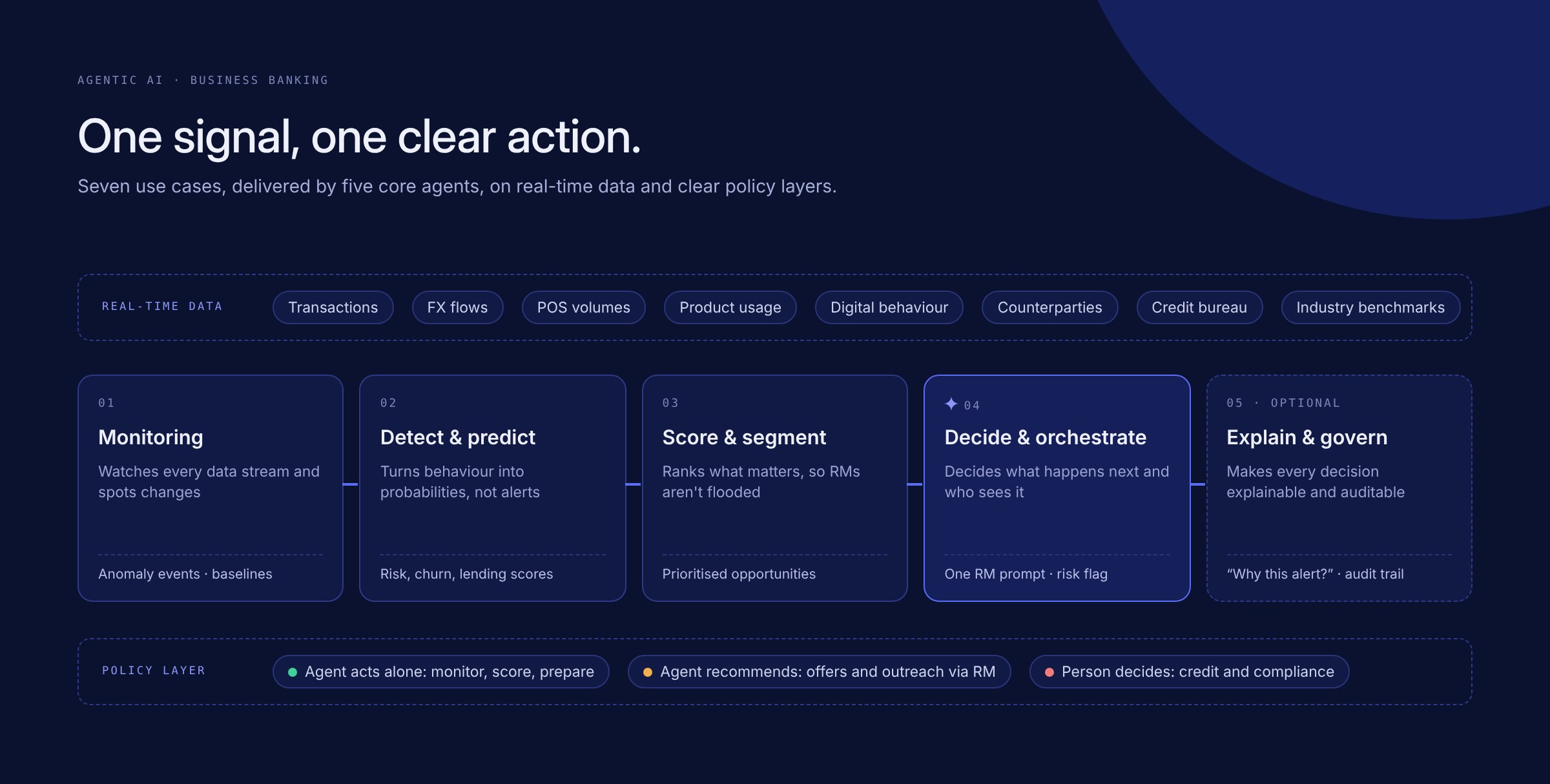
- What the agent does on its own: monitor, score, combine signals and prepare the work, such as an RM brief with context and talking points.
- What it may only recommend: offers, outreach and retention actions go to an RM, who chooses the conversation.
- What a person must decide: credit decisions and anything that touches compliance stay with credit and risk teams.
- What the customer sees: for risk signals, only limited, protective messages, never an unexplained block.
3. Design the agentic flows and the orchestration logic
This is where most of my work sat. We started by sketching one agent per use case. Looking across the flows, the same jobs kept repeating: every use case needed to watch the data, spot a change, score it and decide who should act. So all seven use cases can be delivered with four or five core agents, each doing one job well:
| Core agent | Its job | What it does in practice | What it produces |
|---|
| Monitoring | The backbone: continuously observe data streams and detect changes | Transaction monitor (volume, value, frequency, timing, channels, counterparties) · behavioural monitor (logins, feature use, channel preference, support contacts) · product usage monitor (products held, use, dormancy) | Real-time metrics · anomaly events · baseline updates · revenue leakage alerts |
| Detect & predict | Turn observed behaviour into probabilities, not alerts | Risk predictor (churn, fraud, default) · propensity predictor (lending, cross-sell, reactivation) · value predictor (customer lifetime value) | Risk, churn and lending-readiness scores |
| Score & segment | Group customers into meaningful segments, so RMs aren't flooded | Value, behavioural and lifecycle segmentation · ranking of opportunities | Prioritised opportunities by value, engagement and lifecycle stage |
| Decide & orchestrate | The agentic layer: decide what happens next and who sees what | Applies the policy layer (escalation, suppression, frequency limits) and routes work to the RM portal, the risk queue or an operations workflow | RM alert · dashboard update · early-warning flag · in-app insight (later phase) |
| Explain & govern (optional) | Make AI decisions defensible, auditable and trusted | Generative AI writes plain-language explanations (“why this alert?”) and summaries; analysis and recommendation agents suggest the next best action, a retention or growth strategy, or how to approach a prospect | Explanations · RM briefs · audit trail |
Take risk management and revenue leakage. They look like separate use cases, but both run on the same monitoring agent. One transaction stream feeds the risk lens (is this behaviour still normal for this business?) and the revenue lens (is FX activity moving to a competitor?). The prediction agent scores which is more likely, the segmentation agent sets the priority, and the orchestration agent decides who acts.
Each use case then becomes a flow across these core agents, with its own design principle:
| Use case | Category | Design principle |
|---|
| Behavioural risk monitoring (volume and frequency, sudden spikes, unusual timing) | Risk | One flow with several lenses, not three separate alerts. Customers receive only limited, protective messages. |
| FX revenue protection | Business | Arm RMs with context, not just alerts: what changed, why it matters and what to say. |
| POS lending readiness | Business | Replace generic “apply for a loan” messages with a tailored offer: the right amount, at the right moment, in the right channel. |
| Churn and retention | Business | Pair the flow with RM playbooks and interventions tiered by risk, not free-form outreach. |
| Ecosystem growth | Business | Position it as ecosystem banking: a warm introduction through a shared trading relationship, not cold acquisition. |
Each flow follows the same backbone: a trigger that starts it, the signals that confirm it, the action and who owns it, the outcome for the bank and the customer, and the metric that proves value.
A trigger without a measurable outcome is an idea, not a use case.
The orchestration agent decides what happens when signals meet. The same signal can mean different things: a sustained decline in FX activity can point to revenue leaking to a competitor, or to a customer preparing to leave. Instead of two agents each raising an alert, the orchestration agent routes it to an FX retention conversation or a churn-prevention response, never both in isolation, so the right person gets one clear prompt at the right moment.
Two lessons shaped every flow. First, fewer, richer signals beat more alerts: an RM who gets one clear prompt with context acts on it; an RM who gets ten alerts ignores them. Second, timing matters as much as accuracy: a retention conversation or a lending offer lands best when it follows the customer's real behaviour, before the decision is made elsewhere.
4. Prove value before you scale
Agentic AI is hard to approve in the abstract. Process maps from signal to RM action, and concept screens such as a relationship manager dashboard, let stakeholders see what an agent would surface, what the RM would do with it and where the controls sit, before the bank commits to build. The FX attrition process map and the relationship manager dashboard from this project are in the case study.
How to get started
Banking leaders can test their readiness with five questions:
- Do our AI use cases trace back to our strategic priorities and to real business customer needs?
- Can each agent see the real-time data it needs, and do we know which data is missing?
- Have we written down, for every agent, what it may do alone, what it may only recommend and what a person must decide?
- Who owns the orchestration, so one signal leads to one coherent action?
- What tangible proof of value will we show before we ask for build investment?
The deciding factor is rarely the model. It is the experience design that connects strategic priorities, real-time data, clear policies and human judgement into flows people can trust.
Further reading
See the full case study: Exploring AI Opportunities in SME Banking →
About the author
Selin Sargut Dayan is an independent service and experience designer based between Istanbul and Dubai. She helps banks, government entities and growing businesses design services, digital products and AI-enabled experiences. Get in touch